
This is a Intellectual Community
And it is a space for everyone

I kicked off my keynote speech with a photo of my sole contribution to our re-branded Accepted Society merchandise: The New Face of Academia.
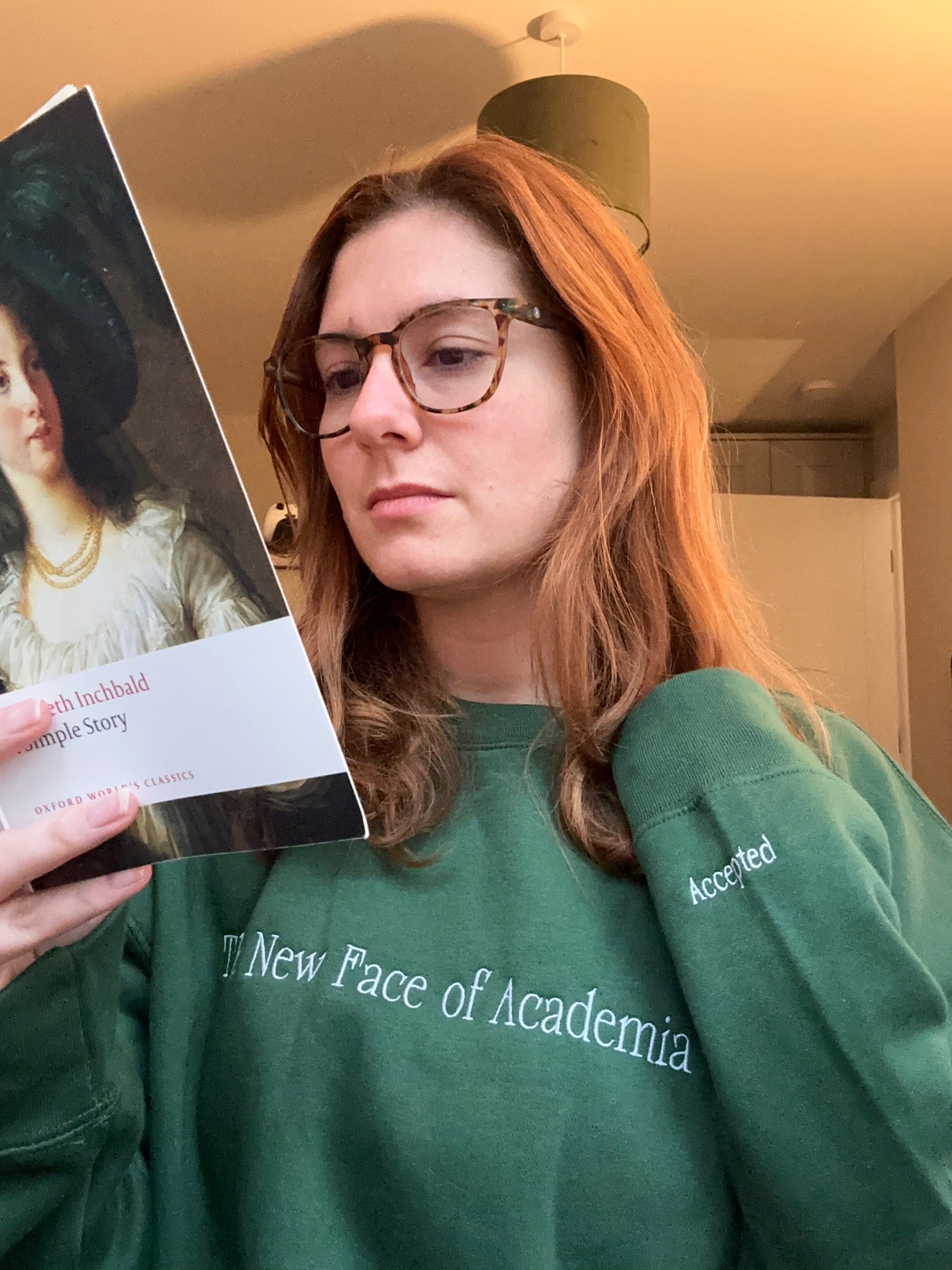
I don’t know where the idea came from or why it stayed with me so long that it needed to be immortalised as a sweatshirt. My one has travelled to Oxford and back, seen late nights, early mornings, stresses and joys, celebrating successes and absorbing tears that fell from over-exhausted eyes. The only other thing that has been with me during all those times is the Accepted Society community. Even back then, in 2024, there was something about the way this community chose diverse pathways and new narratives of scholarship that made me feel like I finally found a place of belonging.
I had a similar feeling of belonging when I first walked through the doors of the Life long Learning Department in Oxford. I had no idea what the future would bring me, all I knew then was that I wanted to keep on learning.
It felt very serendipitous that this year’s Accepted Society Symposium was once again being hosted in the Life Long Learning department at Oxford, not only as a host for the diverse and global community that comes together for the Symposium, but as the pathway that allowed me to pursue my intellectual passion and love of life-long learning, to arrive at their doors once again to advocate for a new face of academia. It occurred to me that we were setting up a space for all kinds of learners: undergraduates, postgraduates and PhD students, as well as independent researchers, and mature and returning students. We all had one thing in common. We were all life long learners, gathered in the Life Long Learning department at Oxford.
It became evident that as a community, we were entering a new era of education. The Symposium was started up five years ago to allow members of the community to have a safe space to share their research. Today, it is a safe space to not only share your research, but it is a safe space that welcomes all forms of intellectual pursuit.
This year, our theme for the Symposium was Rewriting the Narrative. Academia has faced turbulent changes in the last couple of years: funding cuts, a move away from the humanities, and a focus on AI and technology. This year, we planned to change all that. We planned to make education the safe space it deserves to be.
And that was evident by our panelists this year. Both the Introducing the Self to the Scholarship and the Alternative Academia panels embodied the ideas that research is inherently personable, and that each scholar brings their own brand of experience and passion to their work, making them the best people to do the work that they are doing. In a world of academia where you have to have 1001 publications to justify your commitment to the work, it became evident from the panels that there is a different way; academia can exist with a new face if we bring ourselves and our diverse pathways and experience into the scholarship.
This lead in beautifully to Kaelyn’s phenomenal keynote: ‘The Digital Age of Scholarship’. Kaelyn Grace Apple | Historian talked through how we as scholars should be utilising public scholarship as an act of radical resistance and change! By creating spaces in which we can safely share our work and encourage others to do the same, we will destabilise the structures that kept intelligence locked up, and we can be the change we want to see in the institutions.
My keynote highlights this decision to choose our own educational pathways. As someone who has chosen to believe in the power of education, I walked our members through the journey they can expect to forge when they embody their power into this choice. By bringing yourself, your experiences and who you are into the equation of that choice, I argue that you can make your academic pathway work for you. I also looked at the nihilist penguin, the French and American Revolutions, the Romantics, the Renaissance, C.S. Lewis and J. R. R. Tolkien and all the lessons that we can converse with history as a driver for making hard decisions, and standing up for what we know to be right. And standing up together as a community is the way to make the journey less lonely and more impactful. Arms linked, we can all rewrite the narrative and change the face of academia.
Day two saw the embodiment of all that we spoke about above: Kristy | The Strange Scholar’s Golden Scholar keynote reimagined the community as a space of connection and change; as a space of collective life long learning and belonging. The 3-Minute Thesis presenters shared the amazing work that they are currently doing, inspiring the members and showing how scholarship has evolved. Notably, three of our presenters were former members of Researcher cohorts, a testament to the commitment of independent research and its impact. We closed the second day with a workshop by the incredible Polly Hember and Khalia Ii, PhD on debunking the myth of the perfect scholar: it became evident through this workshop that each one of us have a perception of what we should be doing with our work, and that it doesn’t necessarily align with when we do our best work. Receiving validation to that effect, and taking away some key misconceptions, we found ourselves at the end of the day feeling seen, inspired and connected to a deep sense of what it means to be a part of an intellectual community.
Accepted Society is entering into a new chapter. Instead of simply seeking an educational journey into academia, we are creating opportunities beyond its walls; one’s where learning for its own sake is celebrated and encouraged. This is the future of education! It does not stop with a degree. It is a lifelong passion and pursuit.
I love reading your posts, Cait. Your writing always stimulates so many thoughts in my brain, and that’s one of the highest compliments I can give!
Caitlin, that was an awesome keynote! Congratulations!